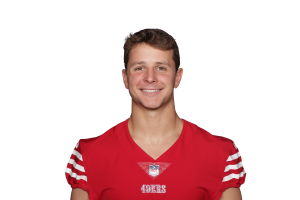
Brock Purdy
 #13
#13BrockPurdy#13
Recent Game
Sun, Oct 11, 2026Gamelog
| Fantasy | Passing | Rushing | |||||||||||||||||||
|---|---|---|---|---|---|---|---|---|---|---|---|---|---|---|---|---|---|---|---|---|---|
| Wk | Opp | Result | PROJ | PPR | SNP% | RANK | CMP | ATT | YDS | CMP% | YPA | TD | INT | LNG | SACK | RTG | CAR | YDS | AVG | TD | LNG |
| 1 | @  LAR LAR | W27-7 | 18.45 | 22.10 | 100 | QB10 | 25 | 34 | 205 | 73.5 | 6.0 | 3 | 1 | 39 | - | 105.6 | 5 | 29 | 5.8 | - | 18 |
| 2 | vs  MIA MIA | W35-13 | 19.99 | 28.48 | 85 | QB5 | 20 | 22 | 287 | 90.9 | 13.1 | 2 | - | 40 | - | 149.1 | 3 | 30 | 10.0 | 1 | 18 |
| 3 | vs  ARI ARI | W36-30 | 21.56 | 31.28 | 100 | QB1 | 15 | 27 | 297 | 55.6 | 11.0 | 4 | - | 82 | - | 133.8 | 2 | 34 | 17.0 | - | 35 |
| 4 | vs  DEN DEN | W24-14 | 20.37 | 19.62 | 100 | QB9 | 19 | 30 | 218 | 63.3 | 7.3 | 2 | - | 56 | - | 107.4 | 10 | 29 | 2.9 | - | 11 |
| 5 | @  SEA SEA | W32-29 | 17.59 | 17.16 | 100 | QB16 | 19 | 29 | 189 | 65.5 | 6.5 | 2 | 1 | 28 | 3 | 92.5 | 5 | 6 | 1.2 | - | 4 |
Career Stats
| Year | Team | CMP | ATT | YDS | CMP% | YPA | TD | INT | SACK | RTG | CAR | YDS | AVG | TD |
|---|---|---|---|---|---|---|---|---|---|---|---|---|---|---|
| 2026 | SF | 98 | 142 | 1196 | 69.0 | 8.4 | 13 | 2 | 3 | 119.3 | 25 | 128 | 5.1 | 1 |
| 2025 | SF | 197 | 284 | 2167 | 69.4 | 7.6 | 20 | 10 | 11 | 100.5 | 33 | 147 | 4.5 | 3 |
| 2024 | SF | 300 | 455 | 3864 | 65.9 | 8.5 | 20 | 12 | 31 | 96.1 | 66 | 323 | 4.9 | 5 |
| 2023 | SF | 308 | 444 | 4280 | 69.4 | 9.6 | 31 | 11 | 28 | 1793.1 | 39 | 144 | 3.7 | 2 |
| 2022 | SF | 114 | 170 | 1374 | 67.1 | 8.1 | 13 | 4 | 11 | 721.2 | 22 | 13 | 0.6 | 1 |
2026 Fantasy Outlook
Purdy was limited to nine games last season because of shoulder and toe injuries. A three-game stretch following the 49ers' Week 14 bye accounted for 41 percent of his season passing yards and 11 of his 20 touchdowns. In his other six games, he averaged just 212 passing yards and had almost as many interceptions as TD passes (9:8 TD:INT). Purdy led the league in on-target percentage (77.8) and was third in completion percentage (69.4), but some of that stemmed from a passing attack that didn't stretch the field as he posted a 7.8-yard average target depth (19th). Nearly two-thirds of his attempts went less than 10 yards downfield, and just 8.8 percent went at least 20 yards (23rd). He didn't get much help in that regard from his receivers. Jauan Jennings was miscast as a No. 1 WR, and Ricky Pearsall was hobbled by a knee injury for much of the season. Purdy's usual gameplan of generating big plays from intermediate throws didn't work either -- YAC accounted for just 40 percent of his yards (32nd). The 49ers let Jennings walk this offseason and signed veterans Mike Evans, Deebo Samuel and Christian Kirk. Evans, though, is coming off an injury-plagued season and will be 33 by Week 1, while Samuel and Kirk are also well past their respective primes. What's more, WR Ricky Pearsall is out for the year with a PCL injury, and tight end George Kittle is uncertain for the start of the season after tearing his Achilles' in the playoffs. The 49ers may need an early impact from rookie wideout De'Zhaun Stribling, counting on the 33rd overall pick with 4.36 speed to at least provide a big-play threat off the bench. If nothing else, Purdy still has Christian McCaffrey to dump it off to and LT Trent Williams protecting his blindside, with Kyle Shanahan dialing up plays for an aging offense that